Showing posts with label book reviews. Show all posts

Monday, August 27, 2012

The 415 Area Code Seems So Fucking Far From Mine.


I used to write all the race reports for Dirty Deeds. It was a pretty fun job, I gotta admit, even if it was time consuming. As well as getting to make any number of jokes about Lewis’ foot fetish, I got to tell the stories of the races, and that’s always the best bit. An added bonus I didn’t anticipate, however, was that I got to know a whole bunch of the folks I was sending these reports to.

One of these folks was Molly Hurford of Cyclocross Magazine – the Girl With The Cowbell Tattoo herself. After the Australian season was over we kept emailing back and forth, and eventually became pretty good friends. I sent her a shirt from this year’s DDCX and she asked me to review her new book – Mud, Snow and Cyclocross: How ‘Cross Took Over US Cycling.

I thought that perhaps I’d have to take off my friend hat and put on my cynical reviewer hat, and that that would cause some ructions. But there was no need – the friendly voice Hurford uses in her personal correspondence is exactly the same as the one she uses in her professional writing. It’s relaxed and breezy, and the fun tone makes the book incredibly easy to read. I sat in the back of an Italian class and knocked over fifty pages without taking an eye off students conjugating verbs.

It’s also obvious that Hurford loves the sport, and she brings an insider’s perspective to the writing. She’s obviously spent a lot of time with the people she’s interviewing, and her familiarity seems to put them at ease – her subjects are generally candid and honest, even if they are disagreeing with each other.

The emphasis on oral history means there are a good variety of voices, and Hurford has gone to considerable lengths to ensure that she has spoken to both a demographically representative sample and also the right voices from the early days of US CX.

Reading this from an Australian perspective gives a good picture of just how far behind we are. This is the first year Australia has had a national series; the States had the SuperCup in the late 90s. The States are hosting the World CX Champs this year; Victoria is hosting their first State CX Champs this year. But it also gives an excellent outline for how the sport can grow in this country. This is particularly true of the chapters outlining the various CX races and series across the states – it’s basically a blueprint for how to grow the sport.

Perhaps even more than other kinds of cycling, CX is about personalities, and Hurford doesn’t neglect this. The section on individual racers gives an excellent idea of who is who in the US CX scene, makes us care about the racers, lets us know the riders who until now were simply names on a results sheet.

My favourite section, however, was easily the CX hijinks chapter – perhaps the best thing about CX is the shenanigans, the willingness of even the elite riders to take the piss. And a chapter dealing with some of the best pranks in US CX is always going to be a highlight. I won’t give away any of the lolz here, but rest assured the book doesn’t shy away from the details.

All in all, it’s a pretty sweet book from a pretty sweet individual, and I enjoyed it a lot. I'm pretty sure you can get in on Amazon, or alternatively go bug Malachi at Northside Wheelers - if anyone could get it in, it's probably him.

Monday, August 20, 2012

We Build Al-Qaeda In Washington.


You step delicately
into the wild world
and your real prize will be
the frantic search.
Want everything. If you break
break going out not in.
- Michael Ondaatje.

FJ is off gallivanting around the city again, leaving me no other option than to write another Heavy Metal Monday myself. I was going to write about metal myself, but given that my exposure to the genre is somewhat limited - pretty much just Gunners, Metallica and a little bit of Slayer, really - I figured it'd be better leaving that to the experts (a humility that hasn't stopped me from writing about cycling, incidentally).

Whenever FJ can't think of what to write about I always tell him to just think about his last bike ride, and write about whatever he was thinking about during that. That works alright for this blog, which is by nature introspective, and ostensibly about cycling. But really, my last ride wasn't that interesting. I did a couple of laps of the Boulie with Hurley and FJ. Hurley was tired, Jamesy wasn't feeling too great, and I was too relaxed to give a shit. We'd started late and headed out on High St, before stopping for Preston Pies. A couple of pies, a bit of After Pie Thinking, then we headed back past New Timer House and hit the Boulie.

Later that night, however, I was in bed reading The English Patient. I kinda get what Elaine is saying in the clip at the top - it's an impractical novel, probably difficult to read if intimate descriptions aren't your thing. It's not even my favourite Ondaatje novel. It's In The Skin Of A Lion that keeps calling me back, that I've read over and over again. Probably partially because of the locations - it's a very Toronto novel, even though it's set in the 1930s. They talk about building the Bloor Street Viaduct and I remember catching the bus over that bridge on my way to Kingston for the start of the University year. They talk about Danforth Street and I remember my friend Caroline who used to live down that way. But also because the novel is so local, so grounded in community. It's almost as if Ondaatje is sitting outside a cafe pointing to local characters as they walk by - look, there goes Alice, she was once a nun but is now an actor; there goes Caravaggio the thief; that man is named Patrick, he is on his way to pick up his daughter Hana from school. As much as it's about the characters, it's about the city, the narrative of one symbiotically resonating in the other. I like that a lot - the idea that part of our identity is geography, that where we are is at least partially responsible for who we are.

In The English Patient, however, the protagonists - all of them - have lost their sense of place, and are trying to rebuild. Two of the main characters are continued from In The Skin Of A Lion - Patrick's daughter Hana (who, incidentally, is actually his stepdaughter, but is referred to throughout the latter novel simply as his daughter), and Caravaggio, who is Patrick's friend. It's the process of them rebuilding that sense of identity that makes the novel kind of amazing, not the romance. Well, actually, I guess the romance is kind of part of it. They find each other and build their new identities through those relationships, through the love that they find. These days we scoff at that kind of thing, because we're all supposed to be independent and not lean on anyone. But that's just bullshit. Every single person we interact with effects who we are, changes who we are, even if only a little. Like Ondaatje himself also writes in the poem that opened this post,

If I speak of death
which you fear now, greatly
it is without answers
except that each
one we know is
in our blood.

I guess, in a way, that the two books are different because one is enclosed within Toronto - or at least Ontario - and the other has the whole wide world to deal with. I guess that's how things are for me at the moment too. Before I only ever thought about the bike, about this small world that wasn't significant to anyone else. But now there's so much more to the world, and that can be a little confusing, a little overwhelming at times. When you're open to the whole world you feel things more acutely, more passionately. I will, however, say one thing. This is better.

Thursday, July 5, 2012

Taking Away My Breath.


Stage Five - Rouen to Saint-Quentin

It's the evening of my 33rd birthday and all of a sudden I'm in my living room surrounded by folks who were also present at my 18th birthday, my 21st, my 30th. In deference to the others present we try not to reminisce too much, but the presence of folks who I've known for so long puts me at ease. We sit in the living room drinking tea. After last night's lack of sleep I'm pretty wrecked, and am already sensing that this is where the evening is going to end. And that's ok.

After folks leave I have a quick look at the stage profile. It's flat, barely a bump, and will almost definitely come down to a sprint finish. And look, I do love sprint finishes - I love the chaos, the drama, the elbows out full contact racing. But I don't love the preceding three hours of knowing that it's going to come down to a sprint finish. That's some boring shit right there. There's no way in hell I'm going to sit up listening to Phil and Paul confuse chateaus and castles for three hours. I grab Franny and Zooey and head to bed.

I'm enjoying the book so much that when I realize that I only have a little bit left, when the pages in my right hand feel thinner and thinner, I'm a bit disappointed. Salinger's great gift is that he makes you feel special, as if you're the only one in the entire world who identifies with the protagonist, and everyone else is either an idiot or a total phoney. It's a good feeling, but it's also isolating, and sometimes I think Salinger knows this, and does what he can to counteract it. That's why when relief finally comes to Franny at the end of the book it only does so when she realizes that the prayer she's repeating is to everyone, that there is no one out there who isn't Christ. I ain't one for god or spirituality, but I too find a sense of relief in imagining that there's some kind of hope in all of us, that we're all, somehow, in this together. It's a nice thought to have at the end of pretty great day. Like Franny, for some minutes, before I fell into a deep, dreamless sleep, I just lay quiet, smiling at the ceiling.

And the next morning I reach for my computer and watch Sagan get tangled in a crash, Cavendish slip too far back, Gossy go too early, Greipel take another win.


Tuesday, February 7, 2012

Shrink To Fit.


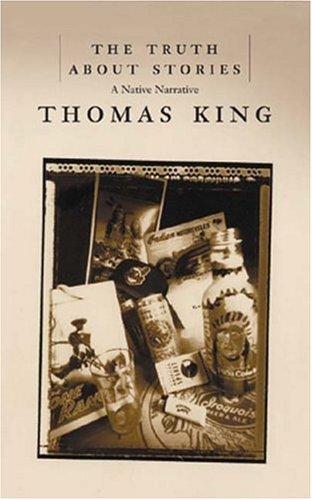
I found this book on a hallstand at my ex-girlfriend's parent's house in Hudson, Quebec. It doesn't belong to me - the sticker on the front cover indicates that its rightful owner is her Grandmother, and even indicates her address in Guelph, should I ever feel the inclination to return it to her. The byline suggests that the book is "a native narrative" (native in this instance should be taken to mean First Nations, or North American Indian), but a better description is in the title. 'Jeez,' I remember thinking, 'That's an ostentatious claim. I better check this out.'

If anything, it's a narrative about narrative. Each and every chapter begins with the same traditional First Nations story, with a few details changed here and there - the location of the story, the description of the character. Immediately after telling the story the author - Thomas King - invokes the title, stating that "The truth about stories is that that's all we are." Then, after telling a number of autobiographical stories, he finishes each and every chapter with slight variations on this paragraph:

"Take this story, for instance. It's yours. Do with it what you will. Cry over it. Get angry. Forget it. But don't say in the years to come that you would have lived your life differently if only you had heard this story.

You've heard it now."

This is a story about me picking up a book that was laying on a hallstand, reading it, reading it again, going back to it and referring to it, and eventually packing it away with the rest of my things when I left that ex-girlfriend. Sure, it's a Canadian book, but when I re-read it now I don't feel any pangs of absence. Nor do I think about that ex-girlfriend, or her parent's house, or her grandmother. I do, however, think about the stories that I tell myself, that I tell other people, that I tell to amuse people, or to scare them, to romance them or intimidate them. Even the posts on this blog labelled 'Opinion' or 'Product Reviews' or even 'Video Clips' are stories. And I guess the reason I'm writing them is to give these stories, which somehow make sense to me, to you. And now, like King says, they're yours. Do with them what you will. Be bored by them. Get angry. Forget them. But don't say in the years to come that you would have lived your life differently if only you had heard these stories.

You're hearing them now.

Wednesday, January 25, 2012

You Ask Too Many Questions.

I've just this last hour or so returned from a few days at a beach house in a secluded town in Victoria's south-east. The house receives no mobile phone signal and has no internet connection. I'd wake up in the morning, throw on some shorts, grab a towel and walk over the road. The path from there was kinda creepy, weaving through the tea-trees, ribbonned with spiderwebs, but eventually it broke out on to the expanse of 90-mile beach. I'd bob around in the water for a bit, swim against the undertow for a couple of minutes, then hike back up to the house.

I hadn't wanted to take a bike at all, but threw in my beater at the last minute, and it was this bike that I'd jump on immediately after drying off. I'd ride the four or five kilometres to Marl's Foodarama (actual name), which, as well as selling newspapers, was the only place in town to receive mobile reception. I'd buy the papers and spend a few minutes checking my emails, answering texts, and generally interacting with the outside world. When that was done I'd ride back to the house, make some cereal and coffee, and spend the next hour or two reading the paper.

My Scottish friend KA Nicholson once asked me if Australian kids, when they're trying to make difficult life choices, really do go down to the beach and stare out at the water, like they do on Home and Away. I was honest with her, of course, and said that they actually do. I didn't do any staring out at the water while I was away, so I guess I didn't have any difficult life choices to make. I did, however, have a number of minor epiphanies while reading Boy Racer, but those were more along the lines of, "Man, as well as being a decent bike racer, Mark Cavendish sure knows how to pick a ghost writer!" and, immediately after finishing, "I'm not going to buy any more books by bike racers whose careers are not yet over. " With the Cav book it was kinda ok, because he'd done a fair bit by the time it came out, and he's definitely a character, but for some reason Nicholas Roche also has a book out, and his career hasn't even really started yet. Just what the hell does he have to write about?

I also borrowed Blakey's copy of Russell Mockridge: The Man In Front, but it was so fucking godawful that I couldn't finish it. And that's really saying something. I mean, I'm pretty tolerant of bad writing - sometimes I can even finish columns written by Anthony Tan. But this book was pretty much the worst biography I've ever read, sporting or otherwise. Part of the problem is the subject matter - while Mockridge was definitely an interesting character, his relatively short life doesn't leave much to write about. However, instead of milking the stories, the interviews and the tall tales, most of this book concentrates on his death and the subsequent coronial inquests. Which, incidentally, is not interesting reading. Nor is it what I want to be reading about while I'm lazing on the beach trying to eliminate my lycra tan.

I also finally finished the Woody Guthrie book. It was pretty good, even if it did result in me having 'Takes A Worried Man' in my head for the entire trip. For the past few days I most certainly have not been a worried man, but apparently not even that can stop me from singing a worried song.